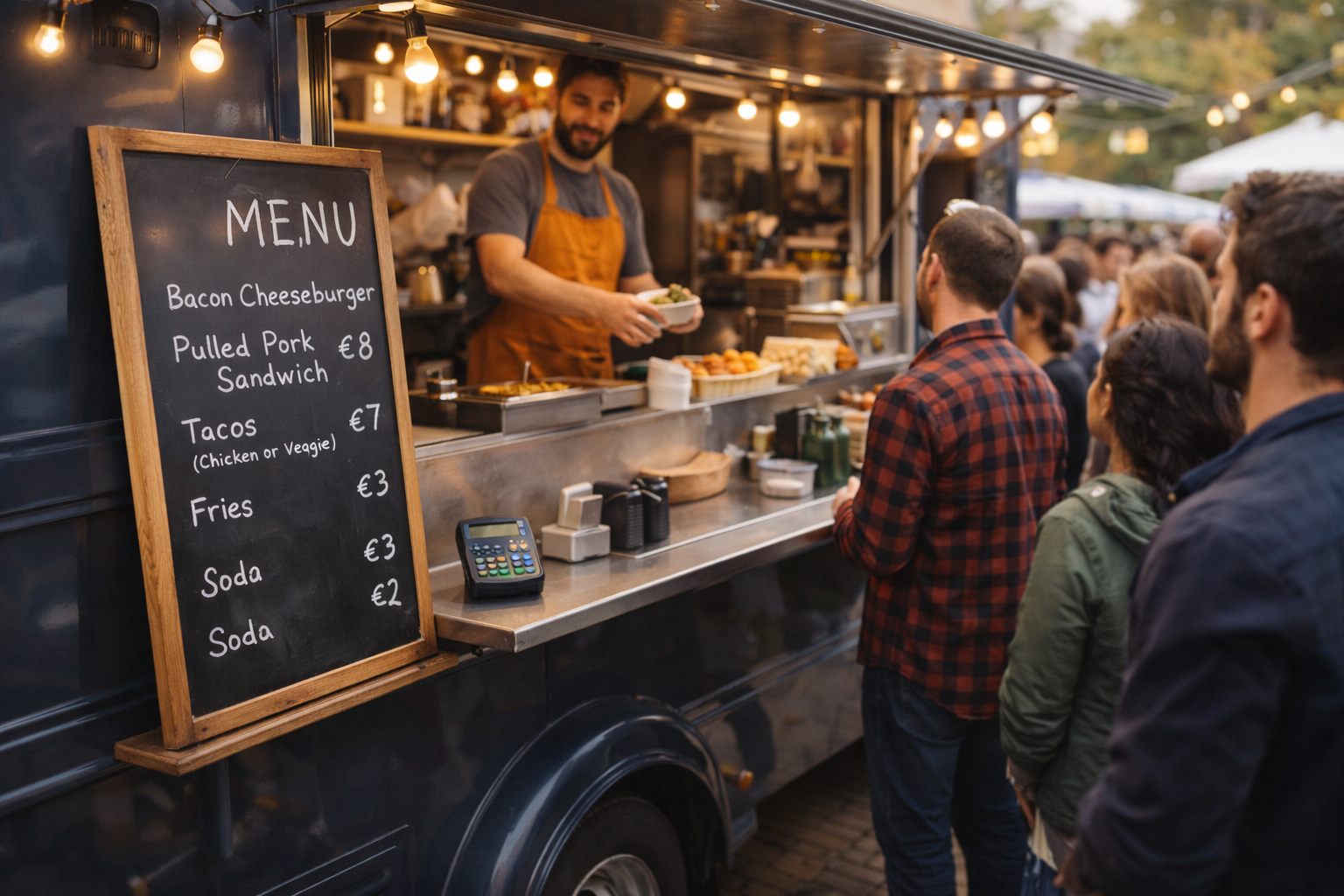
Everyone talks about the food. The menu, the recipes, the Instagram photos of loaded fries and smash burgers. Nobody talks about the costs. And the costs are where most food truck dreams either survive or quietly die.
If you are thinking about starting a food truck in Ireland in 2026 — or if you are already running one and wondering where all your money goes — here is an honest breakdown of what it actually costs. No sugarcoating, no "it depends" hand-waving. Real numbers.
The truck itself
This is your biggest upfront cost, and the range is enormous. A secondhand van that has already been converted for food service might cost €15,000–25,000, depending on condition and equipment. A purpose-built trailer or truck from a specialist converter can run from €30,000 to €60,000 or more. Some operators start with a simple gazebo-and-table setup for markets at a fraction of the cost, but you will outgrow it quickly.
Do not forget the fitout costs if you are converting a van yourself: gas installation (must be certified), electrical work, extraction and ventilation, stainless steel surfaces, water supply, and waste management. Budget €5,000–15,000 on top of the vehicle cost for a proper fitout.
Estimated cost: €15,000–60,000+ (one-time)
Insurance
You will need public liability insurance (typically €6.5 million cover minimum for most markets and events), employer liability if you have staff, product liability, and vehicle insurance. Getting insured as a food truck in Ireland is not always straightforward — not all brokers handle it, and the ones that do know they have a limited market.
Estimated cost: €2,000–5,000/year
Food safety certification and training
You will need to register with the HSE as a food business and have your truck inspected. You will need at least one person with a primary food hygiene certificate (HACCP Level 1 or 2). Some events and local authorities require additional certifications. Budget for the training course, any modifications the environmental health officer requires after inspection, and ongoing compliance.
Estimated cost: €500–1,000 (initial, plus renewals)
Market pitches and event fees
Every market and event charges a pitch fee. Farmers markets typically charge €50–100 per day. Larger festivals and events can charge €150–500 per day, sometimes plus a percentage of sales. Some of the premium locations in Dublin, Cork, and Galway have waiting lists. Regular weekly markets usually offer a discounted rate if you commit to a season.
If you operate from a semi-permanent location (a layby, a car park, outside a pub), you may pay a monthly rent instead — typically €200–500 per month for a good spot.
Estimated cost: €50–200/day (markets) or €200–500/month (fixed pitch)
Fuel and power
Driving to and from markets burns diesel. Running a generator to power your equipment all day burns more. If you are at a market three days a week and travelling to events on weekends, fuel costs add up quickly. A generator running 6–8 hours a day uses roughly €15–25 in fuel per session. Some markets offer mains power hookups, which saves on generator costs but usually comes with a daily fee.
Gas for cooking is another ongoing cost — budget €50–100 per month depending on your menu and volume.
Estimated cost: €200–400/month
Ingredients and packaging
This is your largest ongoing cost and the hardest to pin down because it depends entirely on your menu and volume. The industry rule of thumb is that food cost should be 28–35% of your selling price, but in practice many food truck operators run at 35–45% because they cannot buy in the same volumes as a restaurant and waste is harder to manage when you are estimating daily demand.
Packaging is often underestimated. Biodegradable and compostable packaging (increasingly required at markets) costs significantly more than standard containers. Budget €0.30–0.80 per serving for packaging.
Estimated cost: 35–45% of revenue
Payment processing
Cash is declining. At most markets, 70–85% of transactions are now card payments. Your payment processor will charge 1.5–2.5% per transaction depending on the provider and plan. On top of that, there is usually a monthly terminal fee (€0–30/month depending on the provider). Some processors also charge per-transaction flat fees (e.g. €0.10 per tap).
Estimated cost: 1.5–2.5% of card revenue + €0–30/month terminal fee
Technology — the hidden cost centre
This is the one that catches people off guard. Here is what a typical food truck technology stack looks like and what it costs:
| Tool | Monthly cost | Notes |
|---|---|---|
| Online ordering platform | €100–300 | Plus 2.5–5% commission |
| POS system | €50–100 | Monthly subscription |
| Payment terminal | €0–30 | Some charge monthly, others per-transaction only |
| Loyalty app | €30–50 | If you bother with one |
| Total software cost | €180–480 | Per month, before commission |
That is €2,160–5,760 per year on software alone. For a food truck. And none of these tools share data with each other.
With NibbleOS, you replace all of that with one platform at 2% commission. If you are doing €4,000 a week in sales, that is €80 a week — roughly €347 a month. You get a POS, online ordering, loyalty, customer database, kitchen display, and marketing tools all included. For most food trucks, that works out cheaper than the monthly software stack alone, and you get significantly more functionality.
The first-year summary
Here is a rough first-year budget for a food truck doing around €4,000 per week in revenue at three markets and one or two events per week:
| Category | Annual estimate |
|---|---|
| Truck / trailer (one-time, amortised) | €15,000–60,000 |
| Insurance | €2,000–5,000 |
| Certifications and training | €500–1,000 |
| Pitch and event fees | €5,000–12,000 |
| Fuel and power | €2,400–4,800 |
| Ingredients and packaging (40% of €208k) | €83,200 |
| Payment processing (2% of €208k) | €4,160 |
| Technology (NibbleOS at 2%) | €4,160 |
| Total first-year costs (excl. truck) | €101,420–114,320 |
On €208,000 annual revenue, that leaves roughly €94,000–107,000 before you pay yourself and any staff. That sounds like a lot, but remember — you are working 50–60 hour weeks, often in the rain, and you still need to cover staffing if you have help.
Tips for keeping costs down
- Start small. A secondhand trailer or converted van is perfectly fine for your first year. You can always upgrade when you know the business works.
- Negotiate pitch fees. Commit to a full season at a market for a better weekly rate. Some markets offer reduced rates for new vendors.
- Consolidate your technology. Using one platform instead of four or five separate tools can save €100–300 a month. That is €1,200–3,600 a year straight to your bottom line.
- Track your food cost religiously. The difference between 35% and 42% food cost on €4,000 weekly revenue is €280 a week — €14,560 a year.
- Use pre-orders. Letting customers order ahead reduces waste and speeds up service. NibbleOS includes this out of the box.
- Build a customer list from day one. Repeat customers are the lifeblood of a food truck. A loyalty programme and customer database pay for themselves quickly.
Running a food truck in Ireland is not cheap. But it is achievable if you go in with your eyes open and keep a close watch on where the money goes. The technology piece is one of the few areas where you can make a meaningful saving without sacrificing quality — and that is exactly why we built NibbleOS.